Top 25 Most Dangerous Software Weaknesses

The top 25 most dangerous software weaknesses, based on MITRE CWE, showing the flaws that cause real breaches and how they impact systems across modern applications.
Published on
Tuesday, January 13, 2026
Updated on
January 13, 2026

Key Takeaways:

  • The most dangerous software weaknesses today are the classes of flaws that attackers exploit repeatedly in real systems, primarily injection flaws, memory corruption bugs, and access control failures.
  • Injection weaknesses such as cross-site scripting and SQL injection remain highly prevalent because they are easy to trigger and apply across many modern applications.
  • Memory safety issues continue to cause the most severe technical impact, including crashes and remote code execution, especially in native and legacy codebases.
  • Authorization and authentication mistakes frequently lead to large breaches by allowing users to access data or functions beyond their intended permissions.

What Are Software Weaknesses?

Software weaknesses are flaws in software design, code, or configuration that allow security problems to occur. These weaknesses describe common ways software fails, which is why the same types of security issues appear across different applications and systems.

Because these weaknesses repeat, attackers focus on exploiting the underlying patterns rather than individual bugs. Fixing a single vulnerability does not prevent future issues if the same weakness still exists elsewhere in the codebase.

To address this problem, MITRE documents and standardizes these recurring issues through the Common Weakness Enumeration. MITRE’s analysis shows that many real-world vulnerabilities originate from a relatively small set of well-known software weakness types.

What Is the CWE and Why Does It Exist?

The Common Weakness Enumeration (CWE) exists to standardize how software weaknesses are identified, named, and tracked across the industry. It provides a common reference so security tools, reports, and teams describe the same problem in the same way.

Before CWE, the same weakness could appear under different names in advisories, scanners, and internal documentation. This made it difficult to compare risks, measure trends, or understand whether different issues shared the same root cause.

CWE is maintained by MITRE as part of its work on improving software and system security. By mapping vulnerabilities back to standardized weakness types, MITRE enables organizations to prioritize systemic fixes instead of reacting to isolated findings.

How ahe Rankings Are Determined?

The rankings are created using a data-driven process that reflects how software weaknesses appear and are exploited in real-world systems.

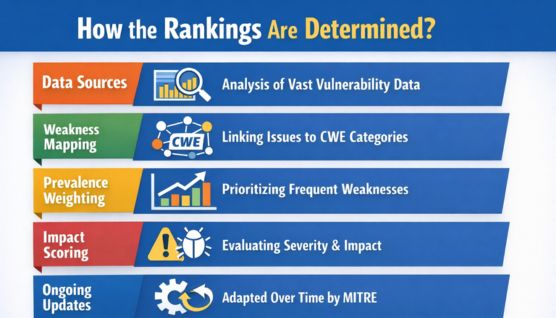
how the rankings are determined
  • Data sources: The analysis is based on large volumes of reported vulnerabilities that are mapped to standardized weakness types. This allows patterns to be identified across different products, vendors, and technologies.
  • Weakness mapping: Each reported vulnerability is linked to an entry in the Common Weakness Enumeration, which makes it possible to group individual issues by their underlying cause instead of treating them in isolation.
  • Prevalence weighting: Weaknesses that appear frequently across vulnerability data are weighted higher in the ranking. This highlights the issues that consistently affect many systems rather than rare edge cases.
  • Impact scoring: Severity is factored in by looking at the typical consequences of exploitation, such as data exposure, privilege escalation, or remote code execution. Weaknesses that lead to higher-impact outcomes rank higher.
  • Ongoing updates: The list is maintained by MITRE and updated as new data becomes available. Rankings shift over time as exploitation trends and attack patterns change.

What Are The 25 Most Dangerous Software Weaknesses?

Rank CWE ID Weakness Name Category Score CVEs in KEV Rank Change vs 2024 Why It’s Dangerous Typical Impact
1CWE-79Cross-Site Scripting (XSS)Injection60.3870Executes attacker scripts in victim browsersSession hijacking, account takeover
2CWE-89SQL InjectionInjection28.7241Manipulates database queries via user inputData breach, authentication bypass
3CWE-352Cross-Site Request Forgery (CSRF)Session Management13.6401Forces actions using authenticated user sessionsUnauthorized actions, data changes
4CWE-862Missing AuthorizationAccess Control13.2805Lacks permission checks on protected functionsUnauthorized access, data exposure
5CWE-787Out-of-Bounds WriteMemory Safety12.6812−3Writes outside allocated memory boundariesRemote code execution, crashes
6CWE-22Path TraversalFile Handling8.9910−1Accesses files outside intended directoriesSensitive file disclosure
7CWE-416Use-After-FreeMemory Safety8.47141Uses memory after it is freedCode execution, instability
8CWE-125Out-of-Bounds ReadMemory Safety7.883−2Reads memory outside allocated buffersSecret leakage, exploit chaining
9CWE-78OS Command InjectionInjection7.8520−2Executes arbitrary system commandsFull system compromise
10CWE-94Code InjectionInjection7.5771Executes attacker-controlled codeApplication takeover
11CWE-120Classic Buffer OverflowMemory Safety6.960N/AOverwrites adjacent memory buffersCode execution, crashes
12CWE-434Unrestricted File UploadFile Handling6.874−2Uploads executable or malicious filesWeb shells, malware
13CWE-476NULL Pointer DereferenceMemory Safety6.4108Dereferences null pointers at runtimeDenial of service
14CWE-121Stack-Based Buffer OverflowMemory Safety5.754N/ACorrupts stack execution flowPrivilege escalation, RCE
15CWE-502Unsafe DeserializationDesign Flaw5.23111Deserializes untrusted attacker inputRemote code execution
16CWE-122Heap-Based Buffer OverflowMemory Safety5.216N/ACorrupts heap memory structuresReliable exploitation
17CWE-863Incorrect AuthorizationAccess Control4.1441Authorization logic enforces rules incorrectlyIDOR, privilege escalation
18CWE-20Improper Input ValidationInput Handling4.092−6Fails to validate untrusted inputInjection, logic bypass
19CWE-284Improper Access ControlAccess Control4.071N/AWeak enforcement of access restrictionsUnauthorized actions
20CWE-200Information ExposureInformation Disclosure4.011−3Leaks sensitive system or user dataCredential and data exposure
21CWE-306Missing Authentication (Critical Function)Authentication3.47114Critical functions lack authentication checksUnauthorized operations
22CWE-918Server-Side Request Forgery (SSRF)Network Interaction3.360−3Makes attacker-controlled internal requestsCloud credential theft
23CWE-77Command InjectionInjection3.152−10Injects parameters into system commandsHost compromise
24CWE-639Authorization Bypass (User-Controlled Key)Access Control2.6206Manipulates identifiers to bypass authorizationCross-user data access
25CWE-770No Resource Limits or ThrottlingResource Management2.5401Exhausts system resourcesDenial of service

How to Read and Use This Table?

The Most Dangerous Software Weaknesses table explains how each weakness is ranked, categorized, and evaluated based on real-world risk and exploitation patterns.

Rank

The rank shows how dangerous each weakness is relative to others in the list. A higher rank reflects a combination of frequent occurrence and severe real-world impact.

CWE ID

The CWE ID links each weakness to its standardized definition in the Common Weakness Enumeration. This allows the same weakness to be referenced consistently across tools, reports, and security documentation.

Score

The score represents a combined measure of how often the weakness appears and how damaging it tends to be when exploited. Higher scores indicate weakness types that repeatedly contribute to serious security incidents.

CVEs in KEV

This column shows how many known exploited vulnerabilities are associated with each weakness. A higher number suggests active and ongoing exploitation in real-world attacks.

Category

The category groups weaknesses by their underlying nature, such as injection, memory safety, or access control. This makes it easier to identify patterns and systemic problem areas across applications.

Typical Impact

Typical impact summarizes the most common outcomes when the weakness is exploited. These impacts include data exposure, remote code execution, privilege escalation, or denial of service.

Patterns and Takeaways from the Most Dangerous Software Weaknesses

The most dangerous software weaknesses cluster into a small number of recurring failure types. These clusters explain where security controls most often break in real systems.

Injection Weaknesses

Injection flaws remain dominant because untrusted input continues to reach interpreters, databases, and command interfaces. Small validation or encoding errors are enough to enable full compromise.

Memory Safety Weaknesses

Memory corruption issues appear frequently because manual memory management is still common in critical components. These weaknesses often lead directly to crashes or remote code execution.

Access Control Weaknesses

Authorization and authentication failures scale across applications rather than affecting single features. One logic error can expose data or functionality for all users.

Persistent Root Causes

Most weaknesses in the list are long-standing and well understood. They persist because development practices do not consistently eliminate them at design time.

How Organizations Should Use the Most Dangerous Software Weaknesses?

Organizations should use the Most Dangerous Software Weaknesses as a prioritization reference rather than a checklist. The list helps identify which underlying problems create the highest risk across products, teams, and environments.

Risk Prioritization

The list highlights weakness types that consistently lead to severe outcomes. Organizations can use this to focus remediation efforts on issues that are most likely to cause real damage.

Secure Design Reviews

These weaknesses should be reviewed during architecture and design phases, not only after vulnerabilities are found. Addressing them early reduces the chance that high-risk patterns are built into systems.

Development Standards

Security standards and coding guidelines can be aligned with the weakness categories in the list. This ensures developers are consistently protecting against the most common failure modes.

Security Testing Focus

Testing activities such as code reviews, threat modeling, and automated scanning can be mapped to these weakness types. This improves coverage and reduces time spent on low-impact findings.

How Developers Can Reduce Exposure to These Weaknesses

Developers reduce exposure to the most dangerous software weaknesses by focusing on a small set of practices that address root causes, not individual bugs. The goal is to prevent high-risk patterns from entering the codebase in the first place.

Input Handling

All external input should be treated as untrusted and validated at clear trust boundaries. Consistent validation and encoding prevent many injection-related weaknesses from forming.

Authorization by Design

Access control decisions should be explicit, centralized, and enforced on every sensitive operation. Relying on assumptions about user roles or request flow is a common source of authorization failures.

Memory Safety

Where possible, developers should prefer memory-safe languages or well-tested abstractions. In environments where manual memory management is required, strict bounds checking and defensive coding are essential.

Secure Defaults

Applications should start in a secure state without requiring manual hardening. Insecure default configurations often turn otherwise minor weaknesses into serious vulnerabilities.

Code Review Focus

Code reviews should actively look for weakness patterns, not just syntax or style issues. Reviewing changes with known high-risk weakness categories in mind improves detection before release.

CWE vs OWASP Top 10

Aspect CWE OWASP Top 10
Focus Software weakness root causes Application security risks
Scope Broad weakness classification system Curated list of common risks
Purpose Prevent vulnerabilities at design and code level Raise awareness of frequent attack patterns
Level Conceptual and structural Application and implementation
Usage Secure design, code reviews, tooling Security testing, training, risk communication
Maintained by MITRE OWASP

Final Thoughts

The most dangerous software weaknesses are not rare or unknown problems, but recurring failures in design and implementation that attackers exploit consistently. Focusing on these weakness classes helps organizations reduce risk at its source instead of reacting to individual incidents.

By using standardized frameworks such as the Common Weakness Enumeration, teams can align development, testing, and security efforts around shared root causes. This approach leads to more resilient software and fewer high-impact security failures over time.

Related Posts
Social Engineering vs Phishing: What’s the Difference?
Phishing uses deceptive messages to steal information, while social engineering covers broader human manipulation tactics across digital and physical channels.
What is Crypto Ransomware?
Crypto ransomware is malware that encrypts files, demands cryptocurrency payment, and causes data loss, downtime, and recovery challenges.
Top 25 Most Dangerous Software Weaknesses
The top 25 most dangerous software weaknesses, based on MITRE CWE, showing the flaws that cause real breaches and how they impact systems across modern applications.

Start your demo now!

Schedule a Demo
Free 7-day trial
No Commitments
100% value guaranteed

Related Knowledge Base Articles

No items found.