🚀 أصبحت CloudSek أول شركة للأمن السيبراني من أصل هندي تتلقى استثمارات منها
اقرأ المزيد
.avif)

Alert correlation links related security alerts into a single attack path, the route an attacker takes from entry to target. Correlation beats cutting alert volume because it surfaces the few real attacks hidden inside thousands of disconnected alerts.
The cost of missing those attacks stays high. The 2025 global average cost of a data breach was $4.44 million, even after a 9% decline. Most breaches are not missed for lack of alerts. They are missed because the alerts that mattered sat unconnected in a flood of noise.
This guide explains why alert volume became the core problem, what the shift from alerts to attack paths means, and how correlation works. It covers internal versus external correlation, the metrics correlation improves, the limitations to plan around, and how to evaluate a correlation capability.
Alert fatigue is the desensitization analysts feel when a constant volume of security alerts overwhelms them, causing real threats to be missed, delayed, or dismissed. The term comes from healthcare, where clinical staff grew numb to constant device alarms. A typical enterprise security operations center handles thousands of alerts a day, and the majority are false positives or low priority.
Four causes drive the overload:
The consequence is a breach hiding in plain sight. In the 2013 Target breach, the company's malware detection tool flagged the intrusion and analysts relayed the alerts, yet no one acted, and the malware exfiltrated about 40 million payment cards over roughly two weeks. Analysts describe this load along four dimensions: volume, velocity, veracity, and variety.
The damage compounds beyond any single breach. Constant triage burns analysts out, turnover rises, and institutional knowledge leaves with them. Each departure slows detection further, widening the window an intruder operates in.
The shift from alerts to attack paths is a shift from isolated notifications to connected stories. Five terms separate the two views:
An attack chain describes the techniques in order. An attack path describes the route those techniques take through the environment toward a target. The distinction drives action: an isolated alert tells an analyst that something happened, while an attack path tells them what to stop and where.
Teams meet alert overload with two different responses. The first reduces volume through suppression and tuning, silencing low-priority alerts. The second correlates alerts, linking related ones into a few high-fidelity attack paths.
Suppression carries a hidden cost. The low-severity alerts it silences are often the early steps of a real attack path. Attackers count on that noise, blending initial access and lateral movement into routine activity. Correlation keeps every signal but connects them, so the attack becomes visible instead of buried.
The result is fewer items to investigate and a clearer picture of each one. Thousands of daily alerts collapse into a handful of attack paths, each showing how an attacker would reach a critical asset. Fewer alerts are not the goal. Seeing the attack is the goal, and correlation reaches it without discarding the evidence.
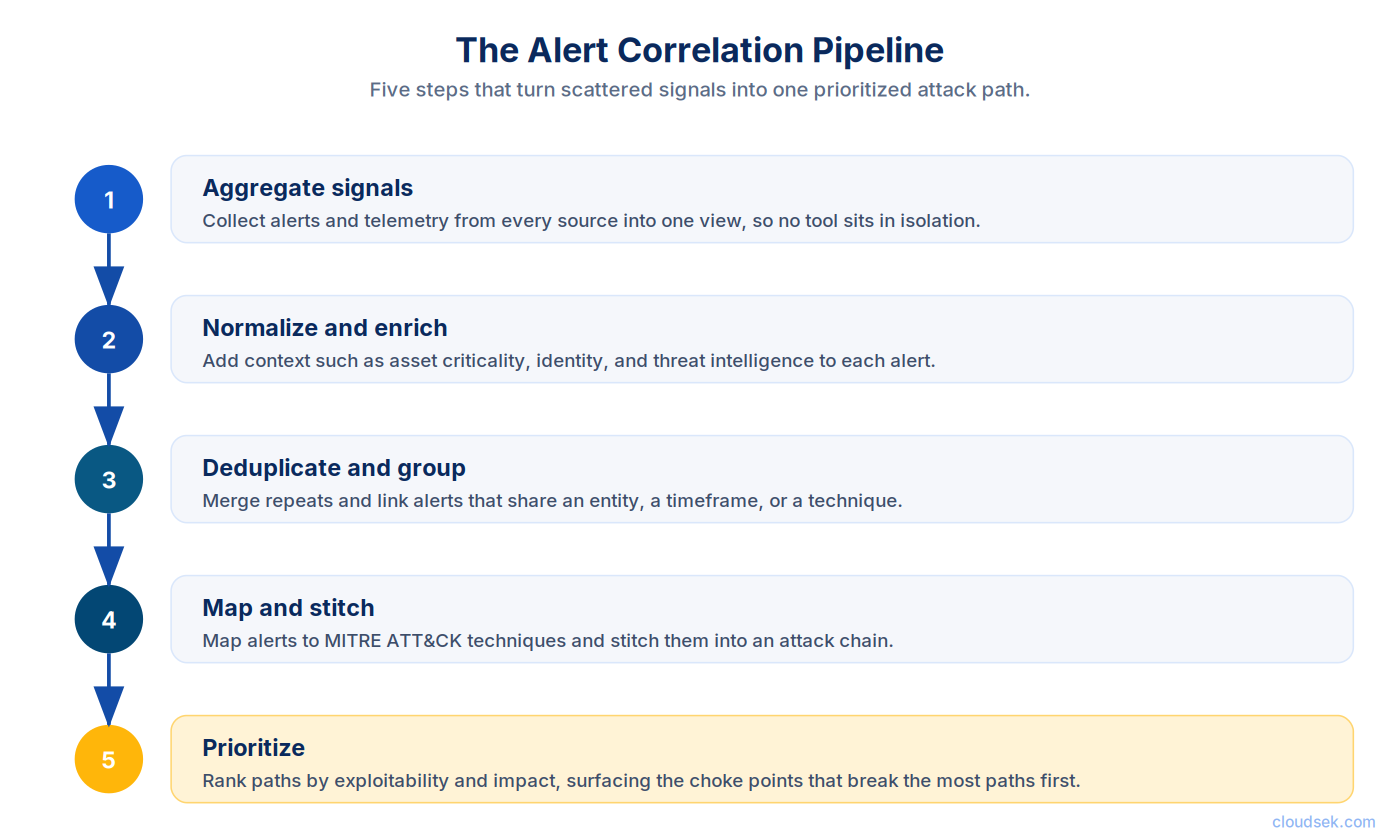
Alert correlation works by turning scattered signals into a connected path. It follows five steps:
Correlation links alerts along several dimensions:
A worked example shows the effect. On their own, a leaked-credential alert, an exposed-server alert, and an unusual-login alert read as three low-priority items. Correlation links them by shared identity and timing into one attack path: stolen credentials, used against an exposed server, to sign in as a real user. One path replaces three alerts, and its priority is obvious.
Correlation happens in two places, and the difference matters. Internal correlation stitches telemetry from inside the network, such as endpoint, network, identity, and cloud logs, into incidents. That work belongs to the security operations center and its detection stack. An endpoint detection, a firewall log, and an identity event become one incident that shows lateral movement.
External and predictive correlation work outside the network. It connects external threat signals, attack surface exposures, AI risks, and third-party weaknesses into predictive attack paths, identifying the initial access vector before an alert ever fires inside the SOC. A leaked credential on a dark web forum, an exposed admin panel, and a vulnerable vendor become one predictive path to the same target.
Most attack paths begin outside the firewall. Correlating external signals shows how an attacker will get in, while internal correlation shows how an attack unfolds once inside.
Correlation improves the metrics that decide breach outcomes:
The payoff is measurable. Breaches took a mean of 241 days to identify and contain in 2025, the lowest in nine years, and organizations using AI and automation extensively across security operations saved an average of $1.9 million per breach. Credential-based attacks, the kind of leaked-credential signal that correlation connects early, took the longest to detect at 292 days.
Nexus AI is the CloudSEK Platform’s attack path intelligence layer. It correlates signals from XVigil, CloudSEK Threat Intelligence, BeVigil, AIVigil, and SVigil into validated attack paths, moving security teams from isolated alerts to a clear route an attacker would take.
Nexus AI correlates external threats, AI, and third-party signals: dark web exposure, threat actor and CVE intelligence, external attack surface findings, AI attack surface risks, and supply chain weaknesses, rather than internal endpoint or network telemetry. It identifies how attackers get in and complements the security operations center instead of replacing its detection stack. This turns fragmented external feeds into one validated attack path rather than another stream of alerts.
CloudSEK's research shows the pattern. In one published finding, AIVigil discovered an unauthenticated MCP server on a customer's AI attack surface. An attacker could chain it into server-side request forgery, local file inclusion, and the theft of live AWS credentials. Nexus AI connects that AI-layer entry point with related signals, such as a leaked credential or an exposed vendor, into one attack path rather than three disconnected alerts.
Correlation carries limitations to plan around:
Strong correlation shows specific traits. Look for a capability that:
The strongest sign is the output. A validated attack path that an analyst can act on beats a longer list of grouped alerts.
Alert correlation is the process of linking related security alerts into a single attack path, so analysts see one connected attack instead of many isolated notifications.
An alert is one notification of a potential event, while an attack path is the connected route from entry to target that related alerts reveal.
Why does correlation reduce alert fatigue better than tuning?
Tuning silences alerts and can hide the early steps of a real attack, while correlation keeps every signal but connects them into fewer, higher-fidelity attack paths.
An attack chain is the ordered sequence of techniques an attacker uses, while an attack path is the route those techniques take through systems toward a target.
Correlation surfaces the full attack path early and hands analysts a ready-made story, which shortens both the time to detect and the time to respond.
SIEM correlation groups log events into alerts and incidents inside the network, while attack path correlation links signals into the route an attacker takes toward a target. CloudSEK applies attack path correlation to external, AI, and third-party signals.
No. Correlation complements the security operations center. CloudSEK correlates digital risk, external attack surface, AI attack surface, and third-party risk signals into attack paths and does not replace internal SIEM or endpoint telemetry.
