🚀 أصبحت CloudSek أول شركة للأمن السيبراني من أصل هندي تتلقى استثمارات منها
اقرأ المزيد
.avif)

Cyber Threat Intelligence (CTI) in board-level cybersecurity reporting is processed threat data that explains cyber risk in business terms for decision-makers. Analysis connects threats, vulnerabilities, and attacker activity to potential impact on operations, revenue, and compliance.
CTI at this level is curated by leadership roles such as the Chief Information Security Officer to ensure relevance and clarity. Structured insights provide the Board of Directors with focused risk visibility instead of technical noise from operational systems.
Alignment with frameworks like NIST and ISO standardizes reporting. Consistent structure improves how directors interpret cyber risk within governance and oversight responsibilities.
Boards need threat intelligence because raw cybersecurity data does not provide business context or decision clarity.
Board reporting requires translating technical threat data into business risk, financial impact, and operational exposure.
Mapping attacker activity to critical assets reveals which systems or processes face the highest risk. Visibility into affected areas shows where disruption or compromise can occur.
Linking vulnerabilities to asset importance highlights potential operational and financial impact. Focus stays on risks that affect core business functions and revenue drivers.
MITRE ATT&CK Framework converts technical attack methods into real-world scenarios. Scenarios outline outcomes such as system downtime, data breaches, or financial loss.
Raw indicators such as IP addresses or malware signatures do not support board-level decisions. Contextual intelligence converts those signals into inputs for investment planning, risk acceptance, and mitigation strategies.
Relevant threat intelligence insights in a board report focus on business impact, exposure, and forward-looking risk rather than technical detail.
Changes in attacker activity reveal whether organizational risk is increasing or stabilizing. Patterns such as ransomware growth or targeted campaigns provide direction for oversight and planning.
Threat activity within the same sector highlights risks that are more likely to materialize. Context around attackers and targets helps align attention with real-world exposure.
Critical systems and sensitive data remain primary targets for attackers. Visibility into exposed assets shows where disruption or loss would create the greatest impact.
Vendors and partners introduce additional entry points into the environment. Risk across the supply chain expands overall exposure beyond internal controls.
Projected attack paths outline how threats could evolve based on current intelligence. Scenario-based insight supports planning around disruption, financial impact, and response readiness.
Threat intelligence improves cyber risk metrics by aligning measurement with threat behavior, attack surface exposure, and business risk signals.
KRIs become more accurate when mapped to real adversary behavior and active campaigns. Intelligence sourced from platforms like Threat Intelligence Platforms ensures metrics reflect current threat conditions rather than static assumptions.
Metrics gain depth when linked to the organization’s attack surface, including internet-facing systems and entry points. Visibility into exposed assets highlights where attackers are most likely to gain access.
Changes in attacker tactics, phishing patterns, or malware usage provide insight into shifting risk levels. Trend-based measurement helps track how threat behavior evolves over time.
Metrics become decision-focused when tied to attributes such as service disruption, data sensitivity, customer impact, and operational downtime. Connection to these signals allows leadership to evaluate risk beyond technical severity.
Structured approaches like FAIR help translate threat data into financial risk estimates. Quantified metrics support clearer prioritization and investment decisions.
Threat intelligence supports board decisions by linking cyber risk to financial impact, control effectiveness, and enterprise risk exposure.
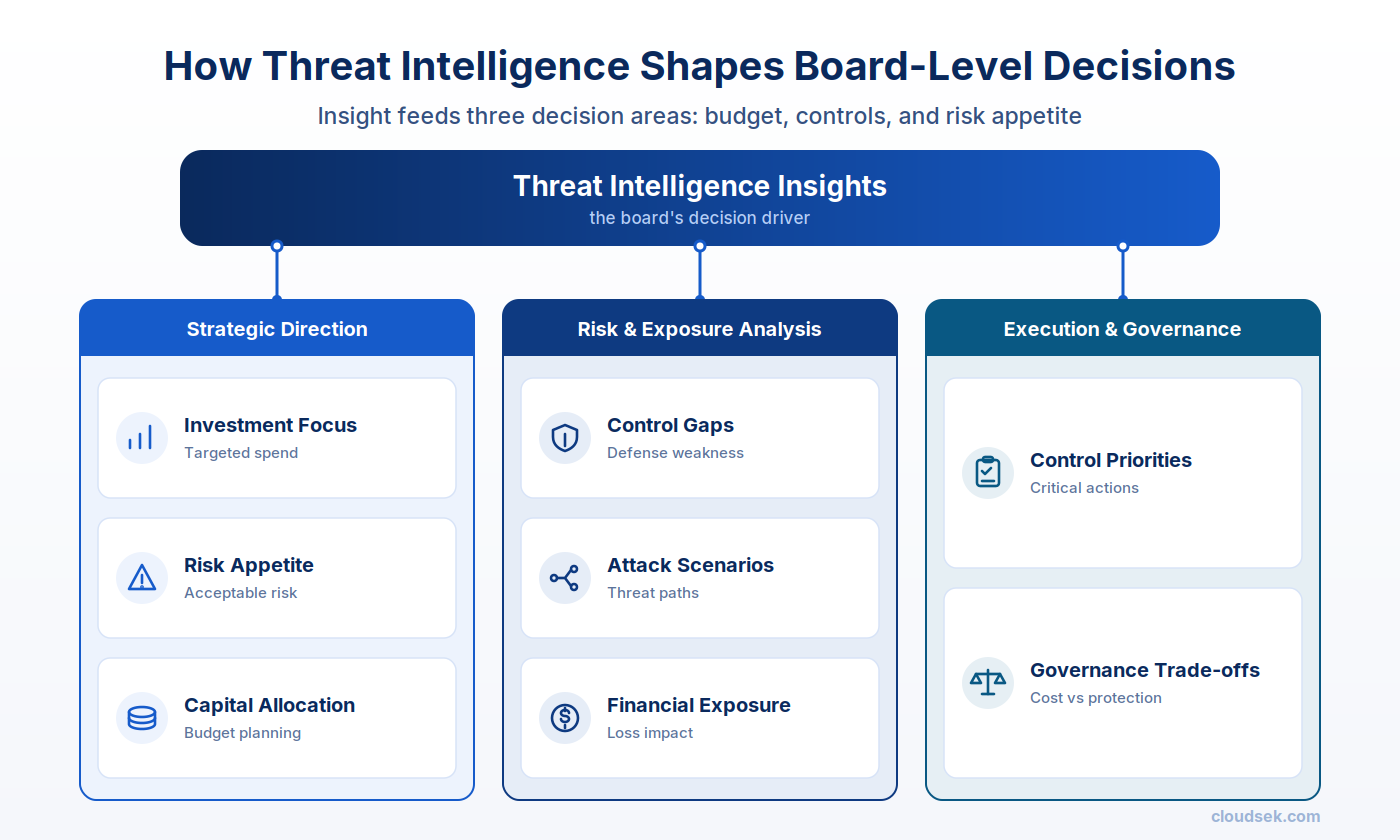
Budget decisions become more precise when aligned with threat patterns targeting critical business functions. Insights derived from Cyber Threat Intelligence help direct spending toward areas with higher probability of exploitation.
Assessment of defensive coverage reveals where security controls fail against current attack methods. Weaknesses across identity systems, endpoints, or cloud environments highlight areas requiring reinforcement.
Defined risk tolerance gains clarity when compared with real threat likelihood and potential impact. Alignment with enterprise risk management ensures cyber exposure fits within acceptable business limits.
Cybersecurity competes with other business investments for funding and attention. Data-driven insights support allocation decisions by connecting risk reduction with financial outcomes.
Modeled attack paths demonstrate how adversaries could move across systems and escalate access. Scenario analysis highlights possible outcomes such as operational disruption or data compromise.
Potential losses from breaches, downtime, or regulatory penalties become clearer with structured intelligence. Estimation of impact supports decisions around mitigation, insurance, or risk transfer.
Security controls must address real attack vectors rather than theoretical risks. Focus shifts toward measures that reduce exposure across entry points and critical systems.
Security decisions require balancing cost, usability, and protection levels. Alignment with governance objectives ensures risk reduction does not disrupt core business operations.
Linking threat activity with incident data allows organizations to assess severity, business impact, and response requirements more accurately.
Defined thresholds determine when an incident requires executive or board-level attention. Data sensitivity, system importance, and spread of compromise influence escalation decisions.
Enriched intelligence reveals attacker intent, origin, and behavioral patterns behind security events. Distinction between targeted attacks, opportunistic attempts, and coordinated campaigns improves understanding of risk.
Alignment between threat behavior and response actions ensures appropriate handling of incidents. Containment, investigation, and recovery efforts follow the nature and progression of the attack.
Impact assessment and materiality guide decisions on external reporting obligations. Regulations such as GDPR depend on understanding data exposure and potential consequences.
Post-incident review highlights affected systems, restoration timelines, and remaining risk. Insight into attack progression supports evaluation of resilience and future readiness.
Regulatory expectations and governance frameworks require cyber risk to be presented in a structured, consistent, and auditable manner.
Threat intelligence connects risk exposure to control structures defined in frameworks like COBIT. Mapping ensures reporting reflects both control effectiveness and current threat conditions.
Regulatory obligations depend on how cyber threats impact data handling, operations, and stakeholder trust. Contextual intelligence highlights which risks could trigger compliance actions.
Categorizing threats based on likelihood, severity, and impact improves consistency in reporting. Standardized classification enables comparison across business units and reporting cycles.
Documented intelligence provides traceability for decisions, actions, and control performance. Audit processes rely on evidence that links threat activity to mitigation steps.
Framework-driven formats ensure cyber risk is communicated in a repeatable and organized way. Structured reporting improves understanding across leadership levels.
Material incidents must align with reporting obligations across jurisdictions and regulatory bodies. Intelligence supports evaluation of impact, timing, and reporting thresholds.
Board-level reporting requires organizing threat intelligence into concise, decision-oriented, and business-aligned communication.
The opening section should present current cyber risk in terms of financial exposure, operational impact, and critical business functions. Immediate focus on impact ensures relevance for leadership.
Recent shifts in attacker activity, targeting patterns, or emerging risks should be highlighted. Emphasis on change keeps reporting dynamic and avoids repetition.
Attention should remain on systems, data, and processes that support core operations. Highlighting exposed or high-value assets directs board attention effectively.
A limited set of KRIs should reflect real exposure and threat-driven risk signals. Selection of meaningful metrics improves clarity and avoids overload.
Illustration of a realistic attack path helps visualize how a threat could impact the organization. Scenario framing supports preparedness and strategic discussion.
Potential outcomes such as downtime, data compromise, or financial loss should be clearly outlined. Linking impact to business functions strengthens decision relevance.
The closing section should define required actions such as investment approval, risk acceptance, or control changes. Clear direction improves board engagement and accountability.
Board-level dashboards must present threat intelligence in a visual, concise, and decision-ready format.
Current threat landscape should highlight active risks and emerging attack patterns. Snapshot gives leadership immediate awareness of overall exposure.
Attack surface visibility shows where vulnerabilities exist across systems and entry points. Focus on external-facing assets improves understanding of risk concentration.
Time-based tracking reveals how threat levels change across reporting periods. Trend visibility supports oversight and long-term planning.
Critical systems and sensitive data should be mapped against threat activity. Connection between assets and risk highlights potential disruption areas.
Vendor and partner exposure expands risk beyond internal systems. External dependencies introduce indirect attack paths that require monitoring.
Ongoing incidents, response progress, and containment updates provide situational awareness. Visibility into current events supports timely decision-making.
Threat intelligence plays a central role in transforming cybersecurity from a technical function into a board-level risk and decision framework. Connection between threat data, business impact, and governance priorities allows leadership to act with clarity and confidence.
Consistent integration of intelligence into reporting improves visibility across risk, investment, and resilience planning. Organizations that structure reporting around meaningful insights rather than raw data enable stronger oversight, faster decisions, and more effective risk management.
Quarterly reporting is common, with additional updates during significant incidents or major threat shifts. Frequency depends on risk exposure, industry requirements, and governance expectations.
Relevance comes from linking threat activity to business impact such as financial loss, operational disruption, or regulatory exposure. Focus on outcomes ensures alignment with board responsibilities.
Operational reporting focuses on alerts, incidents, and technical metrics used by analysts. Board-level reporting focuses on risk, impact, and strategic decisions.
Metrics should reflect exposure, threat activity, and potential impact rather than volume-based data. KRIs tied to risk likelihood and severity provide more meaningful insights.
Threat intelligence helps assess incident impact, materiality, and timing for disclosures. Support for regulations such as GDPR ensures accurate and timely reporting.
Common challenges include excessive technical detail, lack of business context, and unclear communication. Misalignment with governance priorities reduces effectiveness.
Improvement comes from focusing on clarity, prioritization, and business alignment. Structured reporting, meaningful metrics, and scenario-based insights strengthen decision-making.
