🚀 أصبحت CloudSek أول شركة للأمن السيبراني من أصل هندي تتلقى استثمارات منها
اقرأ المزيد
.avif)

Cyber threats are moving faster than manual analysis can track. Ransomware executes in minutes. Phishing campaigns launch and rotate domains within hours. Credential theft happens before anyone notices an unusual login. AI threat intelligence was built to close this gap by analyzing the volume of threat data that human analysts cannot process alone, correlating signals across disconnected systems, and surfacing the attacks that matter before they become breaches.
This guide explains what AI threat intelligence is, how it works, what it detects, and how security teams can implement it effectively.
AI threat intelligence is a cybersecurity approach that uses artificial intelligence, machine learning, and automated analysis to identify, analyze, and prioritize cyber threats across digital environments.
Traditional threat intelligence depends on manual analysis of logs, threat feeds, vulnerabilities, and suspicious activity. AI threat intelligence improves this process by analyzing massive volumes of security data in real time. It helps organizations detect attack patterns, identify abnormal behavior, correlate threat signals, and recognize emerging threats faster across cloud, network, endpoint, and identity environments.
Modern organizations face increasingly complex threats, including ransomware, phishing, API attacks, credential theft, and AI-driven attacks. AI threat intelligence helps security teams improve visibility into these threats, reduce manual workload, prioritize high-risk activity, and respond to incidents more efficiently across large and distributed environments.
AI threat intelligence analyzes large volumes of security data continuously to identify suspicious activity, attack patterns, and emerging threats before they escalate.
AI threat intelligence collects data from multiple sources including security logs, network traffic, cloud activity, endpoints, threat feeds, identity systems, and dark web intelligence, to build a broad, continuously updated view of the threat landscape.
AI systems analyze collected data continuously to identify abnormal behavior, suspicious activity, unusual access patterns, and indicators that may signal cyber threats or active attacks. Behavioral analysis is what separates AI threat intelligence from simple rule-based detection.
AI threat intelligence connects related threat signals, vulnerabilities, indicators of compromise (IOCs), suspicious domains, malware activity, and attack behavior to identify larger attack patterns. Where a human analyst might see three unrelated alerts, AI correlation reveals a single coordinated attack campaign.
AI models evaluate the severity, impact, and likelihood of threats to prioritize high-risk activity that needs immediate attention. This helps security teams focus on the most critical risks first instead of working through alerts in the order they arrive.
AI threat intelligence generates alerts, threat insights, exposure visibility, and response recommendations that help security teams investigate incidents, improve detection accuracy, and strengthen overall security operations.
The core difference is speed and scale. Traditional threat intelligence relies on analysts to collect, review, and connect threat data manually. AI threat intelligence handles the collection and correlation automatically, so analysts focus on decisions rather than data processing.
The shift from traditional to AI threat intelligence is not about replacing analysts. It is about changing what analysts spend their time on. With AI handling data processing and initial correlation, analysts handle investigation, context, and response: the work that requires human judgment.
According to IBM's Cost of a Data Breach Report, organizations using AI-driven threat detection and security automation identified and contained breaches more than 100 days faster on average than organizations without advanced AI security capabilities.
Faster threat detection. AI analyzes security events, network activity, and behavioral patterns in real time to identify suspicious activity and active threats much faster than manual analysis.
Improved threat correlation. Modern attacks generate fragmented signals across endpoints, cloud systems, APIs, identities, and networks. AI threat intelligence connects these indicators automatically to identify coordinated attack campaigns that point-source monitoring would miss.
Better visibility into emerging threats. AI systems continuously monitor evolving threat behavior, new attack techniques, malicious infrastructure, and abnormal activity patterns. This improves visibility into emerging threats before they spread widely.
Reduced security team workload. Security teams process massive volumes of alerts and threat data daily. AI threat intelligence automates repetitive analysis, threat prioritization, and pattern recognition, reducing manual workload and improving operational efficiency.
Stronger attack surface awareness. AI threat intelligence identifies exposed assets, risky integrations, vulnerable systems, leaked credentials, and potential attack paths across cloud, hybrid, and internet-facing environments, including initial access vectors that attackers are actively scanning for.
Faster incident response. AI-driven threat analysis improves response speed by generating real-time alerts, attack context, threat prioritization, and actionable intelligence that help security teams investigate and contain threats quickly.
Reduced false positives. Traditional security systems generate large numbers of inaccurate alerts. AI threat intelligence improves alert accuracy by analyzing behavioral context, threat patterns, and attack relevance before surfacing a security event.
Scalable analysis across environments. Organizations operate across cloud platforms, remote environments, endpoints, APIs, and distributed infrastructure. AI threat intelligence scales threat monitoring efficiently across these large and complex environments without proportional increases in analyst headcount.
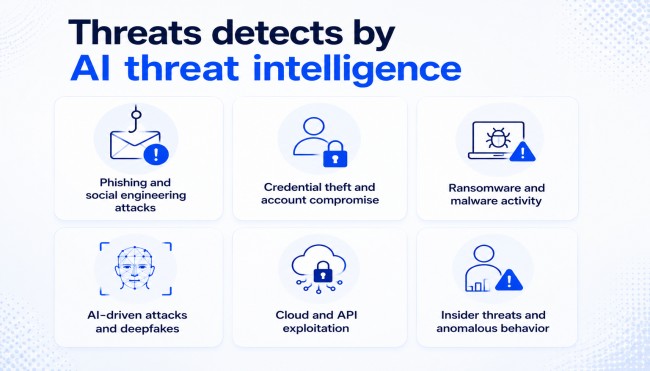
AI threat intelligence analyzes email behavior, malicious links, fake domains, communication patterns, and suspicious user activity to identify phishing campaigns and social engineering attacks before they compromise users or enterprise systems. AI detection is particularly effective against spear phishing campaigns that bypass signature-based filters because they use legitimate-looking content.
Attackers target usernames, passwords, session tokens, and authentication systems to gain unauthorized access. AI threat intelligence detects unusual login behavior, credential abuse, impossible travel activity, and abnormal account access patterns that indicate account compromise, often before any damage is done.
AI systems monitor file behavior, endpoint activity, command execution, and network traffic continuously to identify ransomware encryption patterns, malware communication, and suspicious payload activity across enterprise environments. Early-stage detection, before encryption begins, is where AI has the most impact.
Attackers increasingly use AI-generated phishing content, automated reconnaissance, deepfake media, and synthetic identities to bypass traditional security controls. AI threat intelligence identifies abnormal behavioral patterns, manipulated content, and AI-assisted attack activity that signature-based tools cannot flag.
Cloud environments and APIs create major attack surfaces across modern infrastructure. AI threat intelligence identifies exposed APIs, suspicious cloud access, abnormal API requests, insecure integrations, and unauthorized cloud activity that attackers target as initial access vectors.
Insider threats involve unusual access behavior, unauthorized data movement, privilege misuse, or suspicious internal activity. AI threat intelligence analyzes user behavior and operational patterns continuously to detect activity that differs from normal enterprise operations, without requiring a known signature to match against.
AI threat intelligence works better when organizations combine data from threat feeds, network logs, cloud activity, endpoint telemetry, dark web monitoring, identity systems, and external intelligence sources. Broader visibility improves threat detection accuracy and attack correlation across the full attack surface.
Monitor internet-facing assets, APIs, cloud environments, exposed credentials, and connected services continuously to identify new attack paths and emerging risks before attackers exploit them. Static, periodic assessments miss the exposure that appears between scans.
Large security environments generate massive volumes of alerts and threat indicators. AI threat intelligence should validate threat relevance, reduce false positives, and prioritize high-risk activity based on severity, exposure, and operational impact, not just alert volume.
AI improves threat analysis speed and scalability, but human expertise remains critical for contextual investigation, strategic decision-making, and incident response. Security teams should review and validate high-impact intelligence findings rather than treating AI output as final.
AI threat intelligence systems rely on models, datasets, APIs, and automated processing pipelines. Strong access controls, secure infrastructure, and protected data pipelines reduce risks such as model manipulation, unauthorized access, and data exposure inside the intelligence system itself.
Cyber threats evolve rapidly across cloud environments, identities, APIs, malware infrastructure, and attack techniques. Continuous intelligence updates help organizations identify emerging threats, new indicators of compromise, and evolving attacker behavior, not just the threats that were known last quarter.
Threat intelligence only has value when it connects to the attack paths attackers are actually using. CloudSEK's approach goes beyond alert generation to produce validated attack path intelligence that security teams can act on.
XVigil, CloudSEK's external threat intelligence and digital risk protection platform, monitors the dark web, deep web, threat actor forums, ransomware groups, and surface web continuously. XVigil identifies initial access vectors before attackers exploit them: leaked credentials, targeted threat actor activity, exposed digital assets, and brand impersonation campaigns. It answers the question every security team needs to answer before a breach: who is targeting us and how will they get in?
AIVigil, CloudSEK's AI attack surface monitoring and management platform, covers the AI-layer threats that traditional threat intelligence cannot see. As AI-driven attacks, AI-generated phishing, and automated reconnaissance become standard attacker techniques, the AI systems an organization runs become part of the attack surface. AIVigil continuously discovers exposed AI assets, unapproved MCP servers, shadow AI deployments, and AI infrastructure misconfigurations that attackers scan for as initial access vectors. Where XVigil watches what attackers do outside the organization, AIVigil watches what can be exploited inside the AI layer.
Nexus AI, CloudSEK's attack path intelligence layer, correlates signals from XVigil, AIVigil, and SVigil into a single, validated attack graph. The graph shows exactly how an attacker would chain an external threat signal with an AI-layer vulnerability or a vendor weakness into a real attack path, before they execute it. Security teams move from fragmented alerts to a clear picture of what to disrupt first.
CloudSEK helps enterprises identify how attackers will get in before they do.
