🚀 CloudSEK featured in the 2026 Frost Radar™!
Read more


Network security threats run along a spectrum, from noisy automated attacks that flood a network offline to silent intruders that sit inside it for months. Every one of them exploits a weakness in a network's devices, software, protocols, or people.
The loud end alone is relentless: According to the Gcore Radar report, DDoS attacks climbed to 1.3 million in the last quarter of 2025, a 150% jump in a year, while the quiet end hides in traffic that looks normal until the damage surfaces.
Reading that spectrum is what separates a defender who reacts from one who anticipates. This guide organizes the threats by how they behave rather than listing them at random, then pairs each class with the control that stops it, so the map doubles as a defense plan.
A network security threat is any circumstance or actor with the potential to harm a network by compromising the confidentiality, integrity, or availability of its data and services. Threats act against the three goals of the security triad: stealing data breaks confidentiality, altering it breaks integrity, and knocking services offline breaks availability. The consequences follow those goals in turn, from financial loss and operational downtime to regulatory penalties and lasting reputational damage.
Three related terms cause most confusion, and separating them sharpens the whole topic. A threat is the potential danger, a vulnerability is the weakness the threat exploits, and risk is the likelihood and impact of the two meeting. An attack is a threat carried out, the moment potential becomes action.
Security professionals sort threats along two axes rather than as a flat list, because the axis an attack sits on decides how it is detected and stopped. One axis measures whether the attacker alters traffic; the other measures where the attacker sits.
The two axes combine. A phishing email is an active outsider threat, an eavesdropping tap is a passive outsider threat, and an employee copying data to a personal drive is an active insider threat. Placing a threat on both axes points straight to the controls that apply.
Eight threat classes cover the incidents defenders see most often. Each one exploits a different layer, from the human at the keyboard to the packets on the wire.
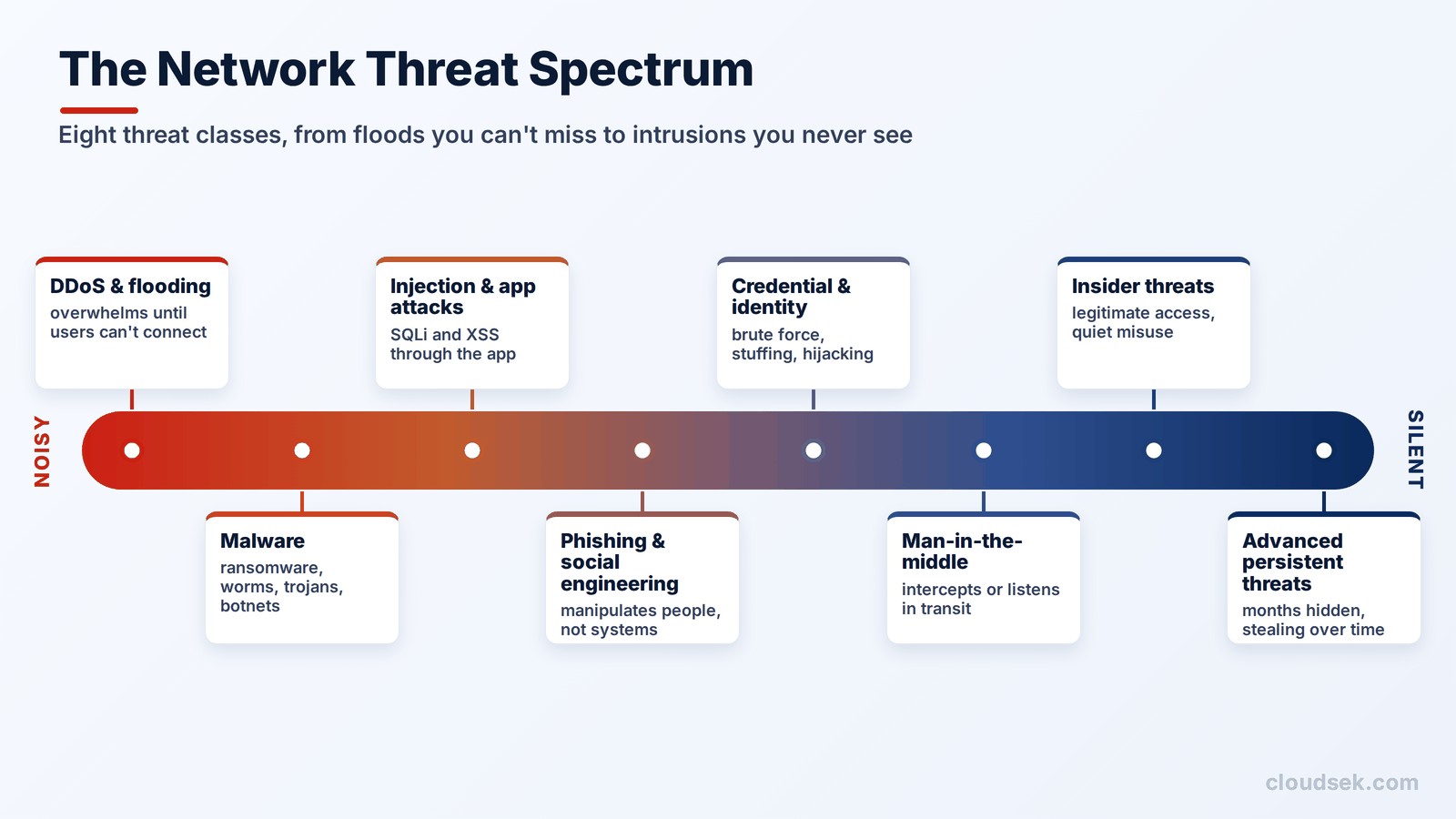
Malware is any software built to damage, disrupt, or gain unauthorized access, and it spans several families. Ransomware encrypts data for extortion, spyware harvests information quietly, worms self-replicate across systems without a host file, trojans hide inside legitimate-looking programs, and botnets conscript infected devices into remote-controlled armies.
Phishing manipulates people into revealing credentials or running malware, and it remains one of the most common ways attackers gain a first foothold. Variants sharpen the aim: spear phishing targets a named individual, whaling targets executives, vishing uses voice calls, and smishing uses text messages, all forms of social engineering that bypass technical controls by targeting judgment.
Denial-of-service attacks overwhelm a network or service with traffic until legitimate users cannot reach it. Distributed versions launch from thousands of compromised devices at once, many of them poorly secured IoT cameras and routers conscripted into botnets. Attack scale keeps climbing as those botnets grow, with single floods now measured in terabits per second. Attackers increasingly use them as a smokescreen for a quieter intrusion running in parallel.
Man-in-the-middle attacks intercept communication between two parties, letting the attacker read or alter data in transit. Unsecured Wi-Fi, compromised routers, and stripped encryption open the door, and the passive form simply listens, harvesting credentials and session tokens without leaving an obvious trace.
Injection attacks feed malicious input into an application to manipulate its behavior. SQL injection rewrites database queries to read or delete records, cross-site scripting runs attacker code in a victim's browser, and both reach the network through the exposed application rather than the perimeter firewall.
Credential attacks target the keys to the network rather than its walls. Brute-force and password-spraying guess weak passwords, credential stuffing replays leaked username-password pairs across sites, and session hijacking steals an authenticated token, each turning a valid login into an attacker's entry point.
Insider threats come from people with legitimate access: malicious employees exfiltrating data, negligent staff falling for phishing, and compromised accounts operated by an outsider. Their legitimate credentials let them bypass perimeter defenses, which makes behavior monitoring the primary means of catching them.
Advanced persistent threats are prolonged, targeted intrusions in which an attacker gains access and stays hidden to steal data over time. Often state-linked or well-funded, they chain several techniques, moving laterally and escalating privileges quietly, and detection depends on spotting subtle anomalies rather than single alarms.
Real attacks rarely stay in one class. The 2017 WannaCry outbreak chained a wormable vulnerability, ransomware payload, and self-propagation to reach hundreds of thousands of systems within days, and modern campaigns blend a DDoS smokescreen with a quiet data theft behind it. Placing each component on the two axes is what untangles a blended attack into defensible parts.
Threats succeed by exploiting vulnerabilities, the weaknesses that sit waiting in most networks. The National Vulnerability Database recorded more than 40,000 new CVEs in 2024, and the unpatched share of them is where many intrusions begin. Seven weaknesses recur across breach after breach.
Detection combines watching the network from inside with watching the exposure outside. Six methods carry most of the load.

No single control stops every threat, so defense layers several so that a failure in one is caught by the next. Mapping each threat class to its primary control turns prevention from a checklist into a plan.
Two foundations sit under the whole table. Network segmentation limits how far any single compromise spreads, and continuous external vulnerability scanning closes the exposed assets attackers reach first, before the internal controls are ever tested.
Artificial intelligence sharpened both ends of the spectrum at once. Automated botnets now scale DDoS floods and vulnerability scanning to machine speed, and generative models write phishing lures free of the language tells that once exposed them.
Identity became the contested ground as a result. Deepfake voices and stolen machine credentials bypass perimeter controls entirely, and defenders increasingly treat identity verification and external exposure monitoring as frontline network defenses rather than supporting ones.
Many network intrusions begin at the edge an organization forgets it has: a subdomain nobody retired, an open port on a test server, an expired certificate, a cloud service spun up outside change control. Attackers map that external surface before they act, and defenders rarely see it as clearly.
CloudSEK BeVigil closes that gap by scanning the external attack surface the way an attacker would, across web apps, mobile apps, APIs, cloud, CVEs, DNS, SSL, and network. It fingerprints internet-facing assets continuously, flags misconfigurations and exposed services as they appear. Nexus AI correlates those findings with CloudSEK Threat Intelligence on active threat actors and exploited CVEs, showing which exposures sit on a realistic attack path.
Placement stays honest. BeVigil covers the internet-facing layer that internal tools like firewalls and endpoint protection don’t inventory, and it complements those controls and DDoS mitigation rather than replacing them.
A threat is the potential danger to a network, while a vulnerability is the weakness that the threat exploits. A threat needs a vulnerability to succeed, and closing the vulnerability removes that path for the threat.
Phishing is among the most common network security threats by volume, but in the 2026 Verizon DBIR, exploitation of unpatched vulnerabilities overtook stolen credentials as the most common way attackers first get in. Both point to the same fix: close known exposures and harden identity.
The difference between active and passive attacks is alteration: a passive attack observes a network without changing it, such as eavesdropping, while an active attack modifies or disrupts it, such as DDoS or injection.
Firewalls stop network security threats by filtering traffic against rules, blocking unauthorized connections and known malicious sources at the network boundary. They do not stop phishing or insider misuse, which bypass the perimeter.
No, a VPN cannot prevent all network attacks. It encrypts traffic and blocks eavesdropping on untrusted networks, yet it does nothing against phishing, malware, or attacks aimed at the destination server.
Ransomware and AI-scaled attacks rank among the biggest network security threats in 2026 by impact, combining record DDoS volumes, machine-written phishing, and identity abuse that bypasses perimeter defenses.
