🚀 CloudSEK featured in the 2026 Frost Radar™!
Read more


Privilege escalation is the technique an attacker uses to gain higher access rights than an initial foothold provides, turning a basic user account into administrator, root, or SYSTEM control over a system. It is rarely the objective of an attack and almost always the step that puts the objective within reach.
That position in the attack chain explains its weight. A stolen low-level login opens the door, escalation unlocks the rooms behind it, and outcomes defenders fear, from data theft to ransomware, depend on the access escalation provides.
Privilege escalation exploits a weakness, a stolen credential, or a misconfiguration to raise an attacker's permissions on a system or network. Operating systems assign every account a privilege level, from a restricted standard user up to root on Linux or SYSTEM on Windows, and each higher level unlocks more control over files, settings, and other accounts.
Attackers pursue elevation because a first foothold rarely holds enough power to matter. Organizations deliberately limit low-level accounts, so an intruder who lands in one gains little until permissions rise. Escalation converts that foothold into the administrative access needed to disable defenses, reach sensitive data, and control network assets.
Danger scales with the privilege gained. Root or SYSTEM control lets an attacker switch off logging, delete backups, and reach every connected asset, which turns a contained incident into a full compromise and marks the difference between a blocked intrusion and a headline breach.
Privilege escalation moves in two directions, and the direction decides what the attacker gains. Horizontal escalation overlaps with lateral movement, spreading sideways across accounts, while vertical escalation climbs upward to greater power.
Real intrusions blend the two. An attacker escalates vertically to gain admin rights on one host, moves horizontally to reach connected systems, then escalates again as each new context demands, repeating the cycle toward high-value assets.
Web applications show horizontal escalation plainly. A flaw that lets a logged-in user alter an identifier in a URL and view another customer's records, known as insecure direct object reference, grants no higher privilege level yet exposes every peer account at once.
A privilege escalation attack unfolds in five stages that form one segment of a larger attack path from entry to objective.
Six technique families cover the escalation routes defenders see most often. Understanding the mechanism, not the exploit code, is what makes detection possible.
Reusing stolen or cracked credentials is a direct route, since a valid privileged login inherits every right the account holds. Attackers harvest passwords, hashes, and tokens through phishing, breaches, and brute force, then authenticate as a more powerful user without exploiting any software flaw.
Attackers exploit programming errors in the operating system, drivers, or applications to run code at a higher privilege level. Kernel flaws draw attackers because kernel code runs with full system authority, so a single memory-corruption bug turns a standard user into root or SYSTEM. Buffer overflows, use-after-free bugs, and race conditions are common vehicles, each corrupting memory to hijack how a program runs.
Overly generous permissions hand attackers elevation without an exploit. An identity system granting users more rights than their role needs, a service running as administrator, or a database exposed to the public internet each open a direct path upward.
Attackers drop payloads that harvest credentials, log keystrokes, or install signed but vulnerable drivers to reach kernel-level control. Malware turns a foothold into a persistent collection point that feeds later escalation.
Manipulating people supplies credentials and access that no technical flaw would yield. A hijacked employee account sends convincing internal phishing, and a spoofed help-desk request tricks staff into resetting a password or approving access to a privileged resource.
On Windows especially, attackers manipulate access tokens to impersonate a more privileged user, and stolen session tokens let them act as an authenticated account without a password. Both techniques inherit privilege from a legitimate session rather than breaking authentication directly.
Escalation techniques track the permission model of each platform, and modern attacks reach beyond the traditional two operating systems into cloud and containers.
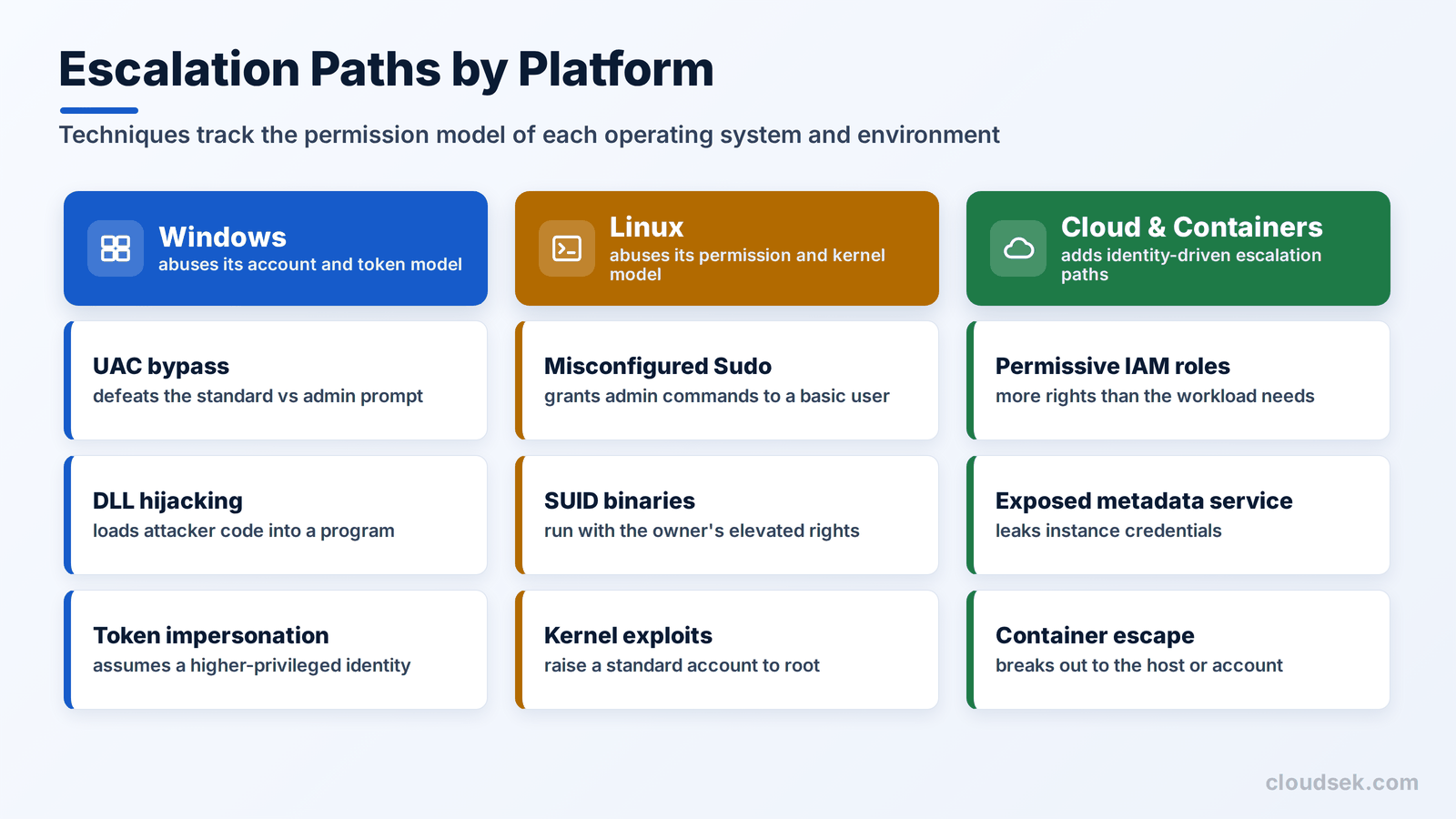
Windows escalation abuses its account and token model. User Account Control bypasses defeat the prompt that separates standard and administrative actions, DLL hijacking tricks a program into loading an attacker's code, and token impersonation lets a process assume the identity of a higher-privileged user.
Linux escalation targets its permission and kernel structure. Misconfigured Sudo rights grant a basic user administrative commands, SUID binaries run with their owner's elevated privileges, and kernel exploits raise a standard account to root outright.
Cloud and container environments add identity-driven escalation paths that perimeter controls miss. Overly permissive IAM roles, exposed instance metadata services, and container escapes let an attacker pivot from a limited workload to control of the wider cloud account without ever touching the network layer.
Real vulnerabilities show how escalation plays out, and recent cases have reached ransomware operations directly. CVE-2024-1086, known as Flipping Pages, was introduced into the Linux kernel in 2014 and patched in January 2024, yet CISA confirmed in late 2025 that ransomware operators were exploiting it on systems still unpatched.

Security teams map privilege escalation to a dedicated MITRE ATT&CK tactic, TA0004, which catalogs the techniques adversaries use to gain higher permissions. Within it, T1068, Exploitation for Privilege Escalation, covers the kernel and software exploits above and sits between initial access and lateral movement in the attack sequence.
Mapping to the framework turns scattered alerts into recognizable stages. Related techniques cover valid-account abuse, scheduled-task manipulation, and access-token theft, and tying detections to these identifiers lets a team see an escalation attempt as one move in a known playbook rather than an isolated event.
Detection relies on behavior, since a successful escalation often uses legitimate accounts and tools. Six signals surface most attempts.
Prevention shrinks both the foothold and the routes upward from it. Six controls carry most of the defense.
Artificial intelligence has widened the escalation problem at the identity layer. AI agents and service accounts authenticate and act on their own, and an agent granted broader permissions than its task needs becomes a standing escalation path that no human logs into.
Attacker tooling advanced in parallel. Machine-assisted reconnaissance maps escalation routes faster than manual enumeration, and non-human credentials multiply the accounts an intruder targets, which pushes identity governance to the center of escalation defense.
Privilege escalation happens inside the network, yet the chain that reaches it usually starts outside, with a leaked credential or an exposed asset an attacker finds before the first login. Disrupting that chain early, before a foothold turns into root, is cheaper than fighting an intruder who already holds admin rights.
CloudSEK Nexus AI correlates leaked credentials, exposed assets, vendor exposure, and threat actor activity into potential attack paths, showing how external weaknesses chain into the initial access that escalation depends on, and which single fix breaks the most chains. Each CloudSEK module covers one of the entry points the stages above depend on. XVigil detects leaked and validated credentials and infostealer logs, the source of the stolen passwords and session tokens behind credential and token-based escalation. BeVigil discovers exposed services and misconfigured cloud assets across eight external attack surfaces. CloudSEK Threat Intelligence tracks which CVEs, including escalation flaws, attackers are actively exploiting, so patching follows real exploitation rather than severity scores. AIVigil covers the AI layer, finding exposed agent infrastructure, leaked AI credentials, and weak agentic workflows.
Placement stays honest. These tools disrupt the path into and through the environment from the outside in, and they complement the internal controls, least privilege, patching, and endpoint detection that stop escalation once an attacker is inside.
Horizontal privilege escalation moves sideways to another account at the same permission level, while vertical privilege escalation moves upward to a higher level, such as a standard user gaining administrator or root rights.
Privilege escalation raises access rights on a system, while lateral movement spreads across systems using existing or elevated credentials. Escalation increases power; lateral movement increases reach, and attacks combine both.
Privilege escalation is a technique, not a vulnerability. It uses vulnerabilities, stolen credentials, or misconfigurations as the means, but the escalation itself is the attacker action of raising permissions.
The goal of privilege escalation is to gain the elevated access, such as administrator or root, needed to disable defenses, reach sensitive data, deploy ransomware, or move deeper into a network.
Attackers escalate privileges on Linux through misconfigured Sudo rights, SUID binaries, and kernel exploits, each raising a standard user account to root, the top privilege level on the system.
No, privilege escalation cannot be prevented completely. Least privilege, patching, MFA, and monitoring sharply reduce the risk and limit the damage, though no control removes every escalation path.
